


Feedback

Last date modified: 2026-Sep-17
Relativity is modernizing how you manage permissions. The Features tab is becoming the primary way to grant access. As each feature modernizes, Relativity manages its granular permissions from the Features tab. These changes roll out feature by feature over time. The
With instance security you can apply permissions to system admin groups to limit or grant access to particular system admin objects.
See the following related pages:
The Features tab lists all features and the permissions they include. For a feature that uses actions, you grant access by selecting actions. An action is the smallest permission unit. For the full model, see Feature permissions.
A feature shows one of three states for the selected group. The state reflects how many of the feature's actions you select.


 Granular permissions
The Object Security tab lists all system admin objects with their related item-level permissions.
Item-level rights include:
 —denies users access to the object.
 —view the object. This is the lowest level object permission.
 —edit and view the object.
 —delete, edit, and view the object.
 —add new objects. This icon turns blue when the setting is unsaved; once you click Save, the blue icon becomes grey. This icon turns green when you give users this permission both when the setting is unsaved and saved.
 —grants users the ability to edit the security of objects. This icon turns blue if you click twice indicating a not applicable status.Object Security tab
These are the granular admin objects you can secure for a group.
You can apply system admin permission settings to any of the following objects in the Object Security tab:
Only system administrators can edit the Client and Matter for a workspace. In addition, the Errors tab is only available to system administrators.
The following objects are secured by default and should not be modified. Please contact Relativity Supportif you need to modify these objects.
The (Admin) Errors tab has been permanently removed from Relativity aiR, and the ability to read errors through the API has been disabled. Job-specific errors are now addressable directly within your workspaces. For more information, see Errors tab deprecation.
If you see the Workspace Processing Settings item listed in the object security section of your console, note that this represents an RDO for which there is no front-end implementation. It stores the Invariant StoreID and Data Grid settings for the workspace, but it provides no functionality, and it controls nothing.
In Relativity, the Tab Visibility setting lets you determine which tabs within the user interface are accessible to specific user groups. This encompasses both parent and child tabs that can be configured for access by these groups. You can enhance user efficiency by combining object security permissions with tab visibility settings. It's essential to understand that tab visibility settings don't alter the permission rights for objects presented on each tab. Instead, they solely govern whether the tab is visible in the navigational menu.
You can make a tab visible to a user even if they lack the necessary permissions to view objects listed on that tab. Nevertheless, it's crucial to understand that tab visibility settings don't restrict access to the objects featured on a particular tab. Users can still access these objects through direct URLs or via the API, even if the tab isn't visible to them in the navigational menu.
Tab Visibility tab list
These are the granular admin tabs you can make visible to a group.
You can alter the following permission settings from the Admin Operations tab of the Admin Security page.
Admin Operations tab
These are the granular admin operations you can grant a group.
The "View Admin Repository" permission is essential for certain features and supported applications to operate correctly. Apart from the specific features that require this permission, it can also be granted to enable users to generate reports and apply filters to Workspace, Client, Matter, User, and Group objects during report setup.
Granting "View Admin Repository" permission to a user provides access to User and Group objects within the platform. This means that these users can retrieve User and Group information, regardless of whether they are using the mobile app.
The following features and supported applications necessitate the "View Admin Repository" permission:
With the Group Permissions Report you can easily assess all permission settings applied to any group. Navigate to the Instance Details tab and click Group Permissions Report.
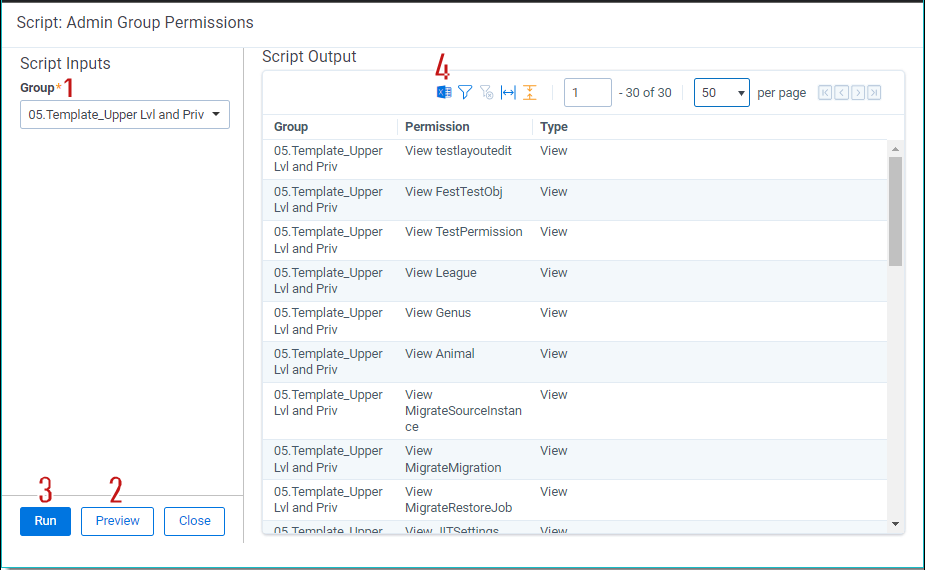
You can perform the following actions from this console:
All users in any instance of Relativity are members of the Everyone group. The following admin permissions apply to the Everyone group by default, and this permission setting configuration is necessary for your Relativity environment to function properly. You can't add or revoke any of the following permission settings on the Everyone group.
Uneditable admin permissions
These admin permissions are fixed for the Everyone group.
System admins are the only users able to access the following items:
Script and application library permissions
These permissions apply to the script and application libraries, for system admins only.
Application Library View:
Application Library Details:
Relativity Script Library view:
New Script page:
Edit Script page:
Run Script page:
The following actions are exclusive to System Administrators and don't require additional permissions:
