Feedback

Last date modified: 2026-Jul-22
You can analyze your contracts by creating and running an analysis set. An analysis set combines an analysis profile with a saved search of documents to run analysis on.
After you run an analysis set, you can review the results and rerun analysis as needed. For more information on analysis sets, see Analysis statuses and results.
There are two general categories of models in Contracts:
You can add either category of model to an analysis profile.
Contracts includes the following models that are ready to run:
| Contracts model type | Description |
|---|---|
| Essential Fields | Auto-populates fields such as contract title, contract type, parties, effective date, and governing law using generative AI. For more information, see Auto-populate essential fields with generative AI. |
| Segmentation | Breaks each document into sections and creates a new document for each section found. For more information, see Segment contracts into sections. |
| Section Classification | Identifies section types for documents in your data source. For more information, see Classify section types. |
| Definition Extraction | Extracts definitions from documents in your data source. For more information, see Extract definitions from contracts. |
| Contract Classification | Auto-populates contract title and type for regions that do not support the Essential Fields model. Do not run Classification if you are in a region that uses Essential Fields. For more information, see Classify contract types. |
The following models require customization before running:
| Contracts model type | Description |
|---|---|
| Regular Expression | Runs all selected regex on your data source and either generates a report, auto populates a field of your choosing, or both, depending on your model configuration. For more information, see Run reports on regular expressions and Auto-populate fields with regular expressions. |
| Regular Expression Segmentation | Uses a regex you create to break up every document in your data source into sections and creates a new document for every section found. For more information, see Segment contracts into sections. |
| Regular Expression Definition Extraction | Uses a regex you create to extract all definitions for every document in your data source. For more information, see Extract definitions from contracts. |
| Document Assembly | Generates a new document for every document in your data source based on your assembly template and field-to-token mapping. For more information, see Automate document assembly based on field values. |
| Unitization | Auto groups documents into families based on shared field values. For more information, see Auto-group families based on shared field values. |
| ML Extraction | Auto-populates text fields by giving you the ability to train a custom machine learning model using previously coded examples as training data. For more information, see Auto-populate fields by training custom ML models. |
The analysis profile includes the following options:
| Analysis profile option | Description |
|---|---|
| Reference Auto linking | Creates links in the document for all instances where text references a section found through segmentation. |
| Batch Size Setting | Determines how many documents an agent processes at a time. If you leave this blank, Contracts defaults to the value set for the Batch Size instance setting in the Contracts AI section. |
| Notifications | Sends an email to the selected user when the analysis set completes. The email includes the number of documents completed, canceled, excluded, and errored, along with a link to the analysis set. |
Following are high-level instructions for running Contracts analysis:
Once you run the analysis, you can review and evaluate your results and rerun analysis as needed.
After running analysis, you may want to evaluate results, adjust your analysis profile, and rerun analysis on the same documents. The steps for rerunning analysis depend on the model type.
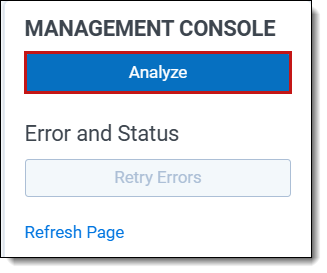
To rerun an analysis set:
To rerun contracts classification:
Contracts will skip any documents for which there is already a value.
To rerun contracts segmentation:
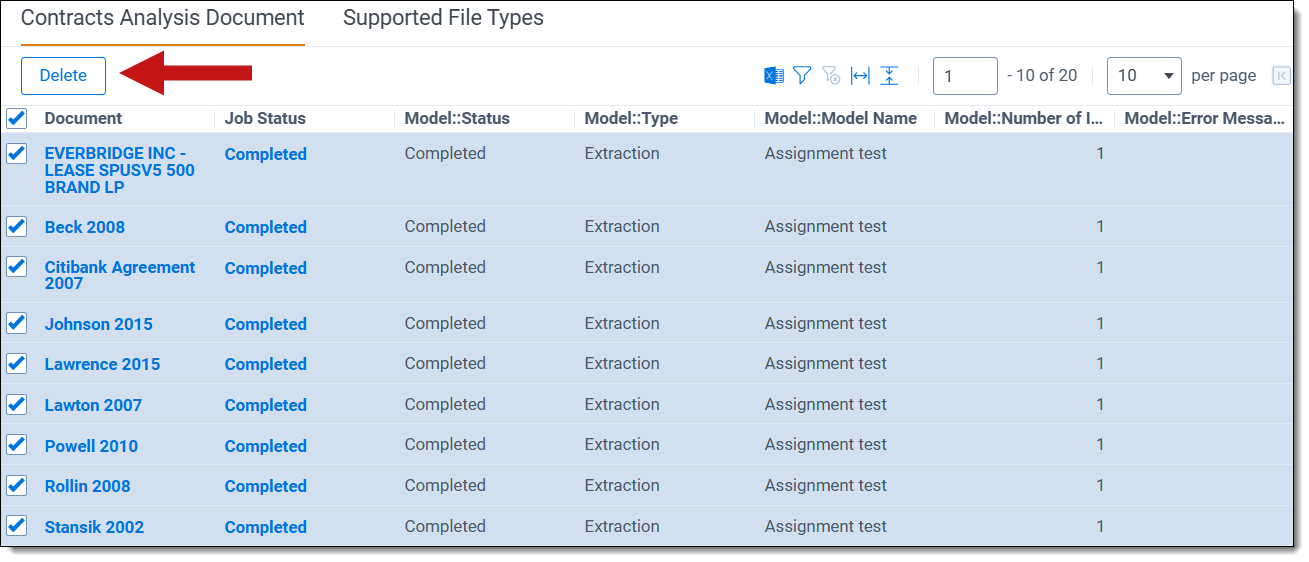
To rerun extraction: