Last date modified: 2026-Feb-11

Indexing data using Index Manager (Advance Access)

Advance Access is an opportunity to evaluate and work with Relativity features prior to General Availability release. Relativity customers typically participate in Advance Access programs on a feature-by-feature basis. The functionality described in this document may not be available in all Relativity environments and may not represent the functionality, appearance or behavior of the General Availability release version of this feature.

Proper data preparation ensures that aiR Assist can generate accurate and well-supported responses. The system relies entirely on the extracted text from documents to build indexes and provide answers. Indexes can also be switched dynamically when submitting questions. This allows users to select which indexed dataset aiR Assist should draw from, enabling flexible exploration of different topics or document collections within the same workspace.

An index in aiR Assist represents the collection of documents that the system can search and use when generating responses. Each index is built from the extracted text of documents available in public saved search within a workspace.

Permissions and access control

Currently, aiR Assist does not include granular permission controls for managing access to indexing or to specific indexes. Any user with access to aiR for Case Strategy and the corresponding workspace can initiate index creation and interact with available indexes.

Permission-based access management for indexing operations and individual indexes is planned as a future enhancement.

Indexes in aiR for Case Strategy

When aiR Assist is used within aiR for Case Strategy, an index can be created either as part of the facts generation process or independently within aiR Assist. Both methods produce the same result, enabling aiR Assist to support case strategy development by leveraging the same document set used in Case Strategy analysis.
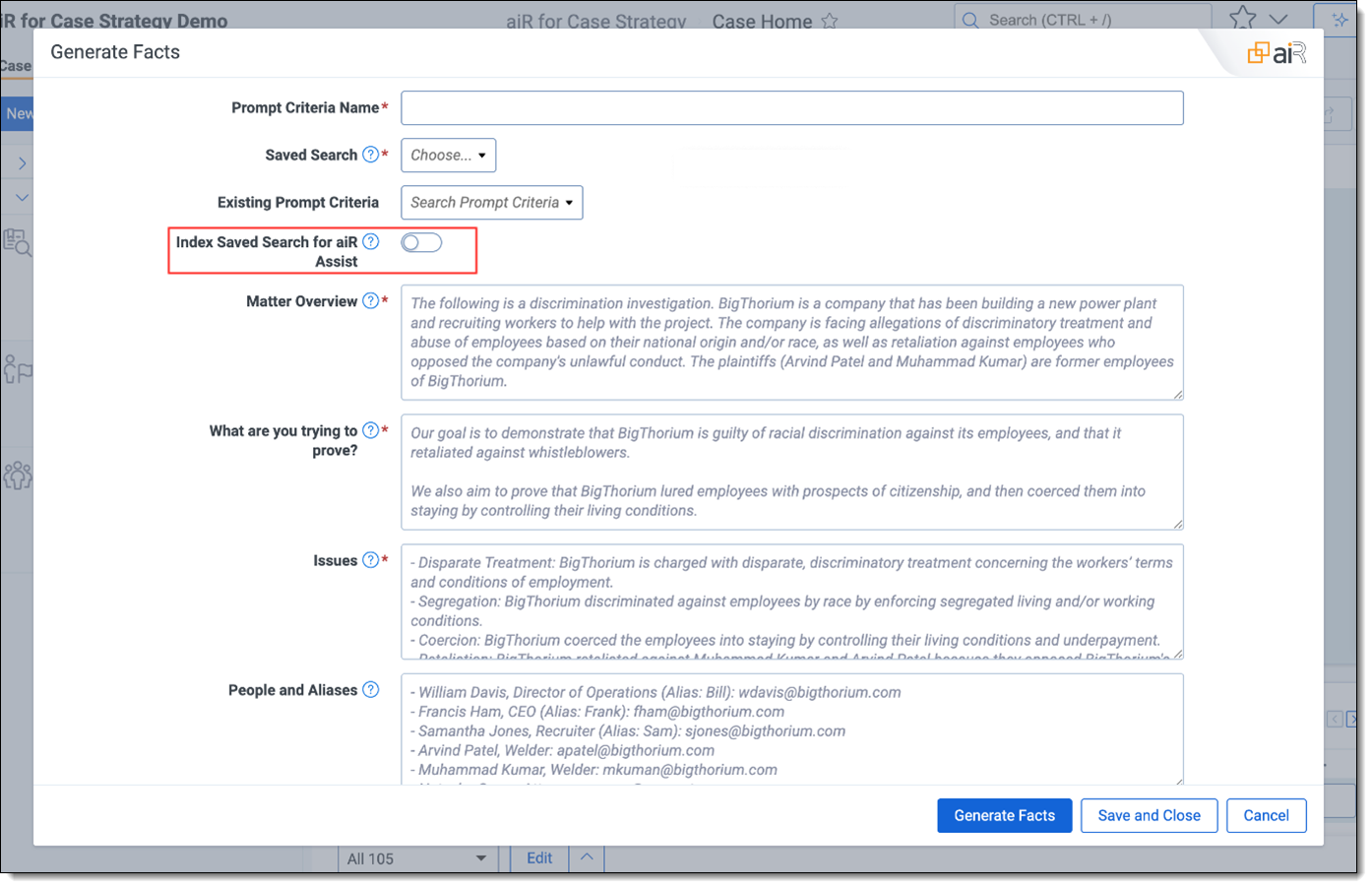
The example below shows how documents can be indexed during the fact generation process in aiR for Case Strategy:

aiR for Case Strategy's Generate Fact dialog with Index Saved Search for aiR Assist option highlighted.

Indexes outside aiR for Case Strategy

When aiR Assist operates outside of aiR for Case Strategy, indexes can be created manually from public saved searches within the workspace.

Each index can include up to 50,000 documents.

A maximum of five (5) indexes can be created per workspace.

The indexes define the datasets from which aiR Assist retrieves and generates answers.

Indexing rules and limitations

To ensure quality and performance, the indexing process follows specific rules:

  • File size limit: Documents larger than 5 MB are automatically skipped during indexing.
  • Text extraction requirement: Only documents with extracted text are included.
  • Content used for generation: aiR Assist uses only the extracted text from indexed documents when retrieving information and generating responses.

Data preparation recommendations

To achieve the best indexing results:

  • Verify that documents contain extracted text to ensure they can be properly indexed and used by aiR Assist.
  • Verify that public saved searches are well-defined and include only relevant materials.
  • Exclude excessively large documents that may be skipped during indexing, in addition to duplicate and known irrelevant documents.
  • Ensure that the Extracted Text field is Data Grid File System (DGFS)–enabled, as aiR Assist does not support environments where the text is stored in SQL.
  • ARM (Archive, Restore, and Move) is not supported for aiR Assist indexes.

Throughput expectations

  • Indexing speed varies by dataset size, document complexity, and available workspace resources. While typical cases are optimized, larger or complex datasets may take more time, possibly up to 12 hours, to finish with either a "Successfully build" or "Partially build" status.
  • Index creation is a background process that progresses automatically once initiated. While exact durations vary, it is recommended to allow sufficient processing time for workspaces containing large volumes of documents or complex extracted text.

Use the Index Manager to select, add, rebuild, and delete indexes.

Multiple users can use aiR Assist in the same workspace and use the same indexes, but each user's session and chat history remain private and separate.

Refer to the following table to learn more about the Index Manager modal.

Index manager modal with callout numbers

Number Name Description
1 Search Use to search for a particular index in the list. Begin typing the name and matching indexes display for selection.
2 Index name Name of the index entered during index set up. Hover over or click the index name to view index details, such as last indexed date/time and by whom, description, and whether all documents were indexed or errors were encounter.
3 Docs Total number of documents in the index.
4 Last indexed Date the index was last indexed.
5 Create Index Click to create a new index. See Creating a new index for more information.
6 Rebuild index Click to rebuild the selected index. See Rebuilding an index for more information.
7 Delete index Click to delete the selected index. See Deleting an index for more information.
8 Set Index Click button after selecting an index to use for querying.

Creating a new index

With Index Manager, you can create up to five indexes for different data sources (Saved Searches) per workspace.

Currently, it is not possible to assign permissions for creating, rebuilding, or deleting an index. Any user who can access aiR Assist within a workspace automatically has these capabilities.

To create a new index using Index Manager:

  1. Access aiR Assist by clicking its icon (aiR Assist icon) at the top of the left nav bar.
  2. From the chat window, navigate to the Index Manager by clicking the index name in the lower corner of the Ask a question box.Name of the indexed highlighted in the lower left corner of the Ask a question box.
  3. Click the Create Index (+) icon in the lower left corner of the Index Manager list.
    Index manager dialog
  4. Fill in the following fields:
    Create an aiR Assist Index modal with fields to be entered.
    • Source—choose a public saved search as the document source for your index. The index will be built from the extracted text of documents in that saved search. Only public saved searches are available for use.
    • Name—enter a unique, clearly descriptive name for the new index so its contents and purpose are identifiable by any user. Must be at least six characters long.
    • Description (optional)—optionally add a description of the index, such as its use case or intended function. This information may assist other users in the workspace who might use it.
    aiR Assist indexes are shared by all aiR Assist users within the workspace, so keep that in mind as you name and describe each one.
  5. Click Create Index. Indexing progress appears below the new index name. See Monitoring the index build process for information.

You can access other indexes or create new ones while the index is building.

 
  • The Ask a question box is not available while documents are being indexed.
  • aiR Assist indexes are shared by all users within the workspace.

Rebuilding an index

If your data source (saved search) changes by either adding or removing documents to it, the index must be updated (rebuilt) to reflect those changes for aiR Assist to use the new information in its queries.

Currently, it is not possible to assign permissions for creating, rebuilding, or deleting an index. Any user who can access aiR Assist within a workspace automatically has these capabilities.

To rebuild an index from the Index Manager:

  1. Access aiR Assist by clicking its icon (aiR Assist icon) at the top of the left nav bar.
  2. Navigate to the Index Manager from the chat window by clicking the index name in the lower corner of the Ask a question box.
    Name of the indexed highlighted in the lower left corner of the Ask a question box.
  3. Select the desired index to rebuild.
    Index Manager dialog
  4. Click the Rebuild curved arrow icon. Refer to Navigating Index Manager for navigation details. A confirmation message notifies you that the index is unavailable while it is rebuilding.
  5. Click Rebuild to proceed. Indexing progress appears below the new index name. See Monitoring the index build process for information.

Deleting an index

Use the steps below to easily delete indexes from the index list. Deleting an index does not erase past questions and answers, which remain accessible in your chat history.

Currently, it is not possible to assign permissions for creating, rebuilding, or deleting an index. Any user who can access aiR Assist within a workspace automatically has these capabilities.

To delete an index from the Index Manager:

  1. Access aiR Assist by clicking its icon (aiR Assist icon) at the top of the left nav bar.
  2. Navigate to the Index Manager from the chat window by clicking the index name in the lower corner of the Ask a question box.
    Name of the indexed highlighted in the lower left corner of the Ask a question box.
  3. Select the desired index to delete.
    Index Manager dialog.
  4. Click the Delete Index trash can icon. Refer to Navigating Index Manager for navigation details. A warning message notifies you that the delete action cannot be undone.
  5. Click Delete to proceed with permanently deleting the selected indexes.

Monitoring the index build process

After initiating the index build process, the Index Manager displays “Indexing in progress” information.

Index manager with highlighted index build in progress.

The index can complete in two possible states:

  • Successfully built
    The index is considered successfully built when all documents included in the selected saved search (or Case Home set) are indexed without errors. In this case, the progress section reads: "All documents were indexed." The index is immediately available for use in aiR Assist.
    Index manager with highlighted index build successful
  • Partially built
    The index may be partially built when some documents could not be indexed. In this case, the progress section reads: "[#] documents were indexed. [#] documents were not indexed." When errors occur, click View errors to see a list of errored documents or click Try again to rebuild the index. See Error handling and retrying index jobs and Indexing rules and limitations for more information.
    Index manager with highlighted index build showing partial build, number of documents indexed and not indexed, and options to try again and view errors.

Error handling and retrying index jobs

aiR Assist provides error messages and offers retry options for indexes that are partially built. If an index fails, you can click Try again to rerun it, or you can click View errors to investigate the Indexing Error List. For more information, see Indexing rules and limitations.

  1. From the Index Manager, click on the name of the index that was partially built to view details.
    Index manager showing error details for a indexed saved search.
  2. Do any of the following:
    • Click Try again to rebuild the index to see if the errors are corrected.
    • Click View errors to review the Indexing Error List.
  3. When View errors is clicked, the Indexing Error List appears next to the aiR Assist pane. It covers any application you have open, such as the Documents List. The name of the selected index appears next to the Not Indexed Documents label at the top.
    • To filter the list, click one of the indexing error types in the panel above the list or use the Indexing Error Type column to select one from the list.
    • To view the full list again, click Not Indexed in the panel.
    • To view a document further in the Viewer, click its Control Number. Closing the Viewer returns you to the error list.
    • To close the error list and return to the previously opened application, click the X in the upper right corner of the error list.
    Index errors list showing name of selected index, indexing error type panel, control number colum, and indexing error type column.
Return to top of the page
Feedback