


Feedback

Last date modified: 2026-Sep-18
A preservation data source defines the third‑party system where preservation holds are applied. Preservation data sources connect Relativity to supported third‑party applications, which perform and enforce preservation holds on the data where it resides.
You must set up preservation data sources in your workspace before initiating preservations. Relativity uses these data sources to send preservation requests, record activity, and track hold status, while the third‑party application remains the authoritative preservation system for whether data is preserved.
See these related topics:
There are multiple data sources to create within the Preservation app. Some sources need extra steps, but there is a general creation workflow.
To add a preservation data source:
For data source-specific setup procedures, see Google Workspace preservation source and Microsoft 365 preservation source.
After creating a data source, you can view the details page. The view includes the information you provided when creating the data source. For example, the Microsoft 365 data source page includes the client ID, certificate, and domain.
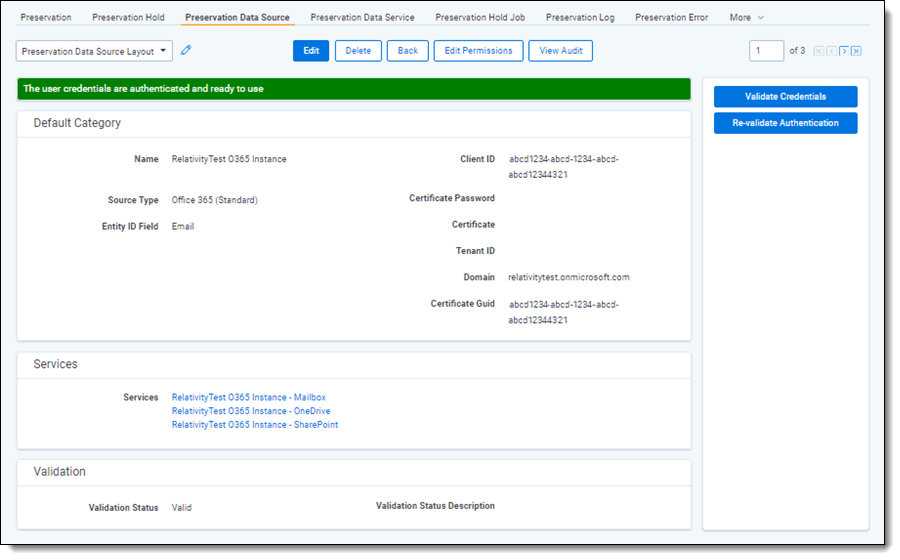
Each data source details page includes a console to complete actions. Each data source has different actions.
When visiting the page, the banner will automatically retrieve the status of authentication or validation. If status is success or error, the UI displays the appropriate banner and stops refreshing. If the status is one that needs further refreshes, Relativity continues to refresh every 10 seconds.
You can hide a data source from being displayed in the preservation wizard. Select No on the Show in Wizard field. Select No when you want to hide invalid data sources to users when they're configuring holds. With only valid data sources shown, users can see a clean view of only configured data sources.
When you create a data source, you are connecting to data services. For example, you integrate Microsoft 365 with Relativity aiR. After integrating the Microsoft 365 data source, you can select Microsoft data services. Microsoft data services include Microsoft 365 mailbox, SharePoint, and OneDrive.
You will select these data services in the Preservation wizard. For more information, see Creating a preservation.
You can review these data services in the Preservation Data Service tab. On this data services list page, you can click into an existing data service. For example, you can click into the a Microsoft 365 SharePoint service. On the SharePoint data service details page, you will see a console with a Refresh Sites button. Click Refresh Sites to identify and add new SharePoint sites that were added after the initial integration with Microsoft.
When you click Refresh Sites, Legal Hold enumerates your Microsoft 365 tenant through the Microsoft Graph API. The API returns every site in the tenant. It cannot filter by site type or template. As a result, the total site count in Legal Hold may be higher than the count shown in the Microsoft SharePoint admin center.
The SharePoint admin center displays only a subset of sites in its Active sites view. Sites that the admin center excludes but Legal Hold includes are:
This difference in counts is expected. Legal Hold reflects the full set of sites returned by the Microsoft Graph API, while the SharePoint admin center applies its own filters to that same tenant data.
