This site is currently undergoing maintenance, so instances of "RelativityOne" may still be present. You may also experience 404 errors, search disruptions, and temporary style changes.

Last date modified: 2026-Sep-21

Relativity FOIA

The Freedom of Information Act (FOIA) is a federal law that gives the public the right to request access to records from government agencies, promoting transparency and accountability. Relativity Government is being modernized to help agencies manage the entire FOIA process with a modular, AI-powered ecosystem that streamlines intake, tracking, review, publication, and reporting. By integrating secure infrastructure and automated tools, Relativity FOIA enables agencies to efficiently process requests, apply statutory exemptions, and maintain oversight throughout the FOIA life cycle.

Public and agency portals

Relativity supports FOIA operations through two portals: a public-facing Public Portal and the agency-only Relativity FOIA environment. Public access to the Public Portal is provided through the government-managed authentication service, Login.gov. Agency users access FOIA functionality through Relativity. The Public Portal is fully integrated with Relativity to ensure a seamless experience.

Public Portal

The Public Portal is the public-facing interface that allows users to view released documents, submit new FOIA requests, and track request status. It integrates seamlessly with agency systems, creating a unified and efficient communication channel between public users and agencies.

Navigation options include:
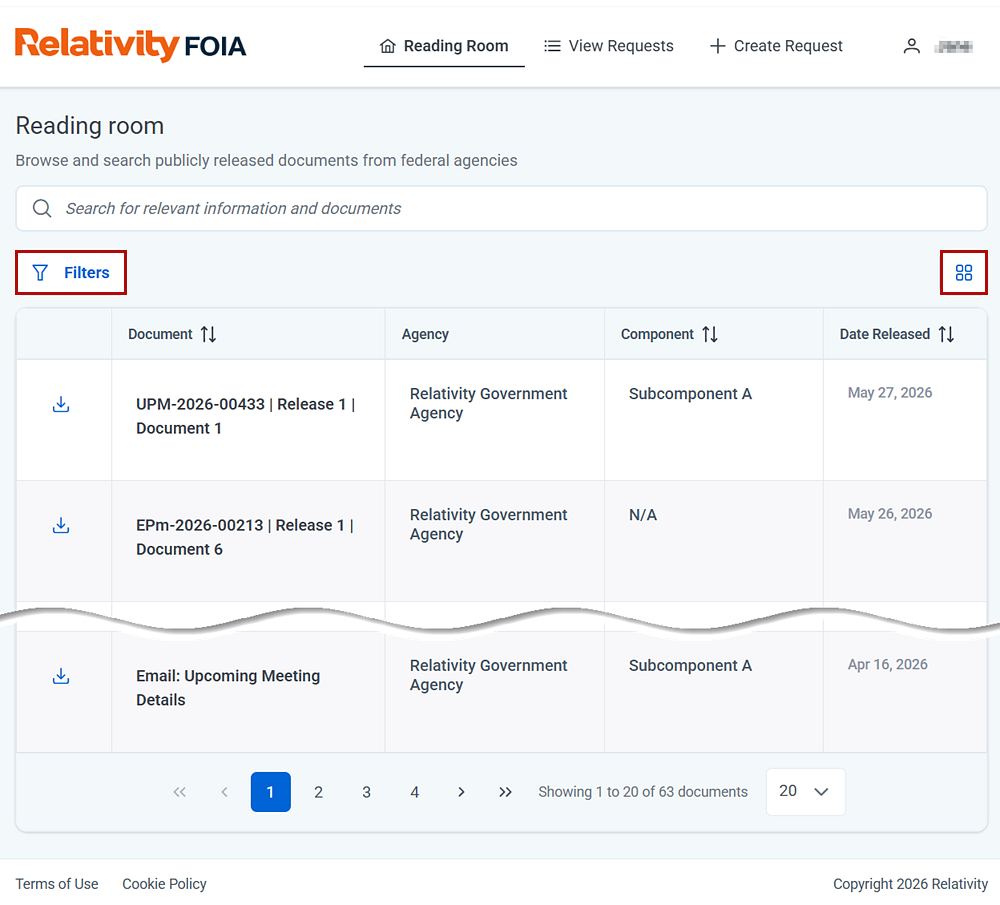
  • Reading Room—search, read, and download released documents.
  • View Requests—track the status of requests.
  • Create Request—submit new FOIA requests (available in GA).
    The Reading Room is where you can find released documents, and submit new requests for documents.

See Public Portal for details on the portal's features and use.

Relativity FOIA

Relativity FOIA is the agency access point for receiving, searching, reviewing, and responding to FOIA requests. Click FOIA in the Relativity sidebar to access the environment. The FOIA landing page features a dashboard display of request statistics, along with a list of recently submitted requests. Click the Request ID to open a request. From there, you can drill down further into the workflow steps: Intake, Search, Review, and Response.
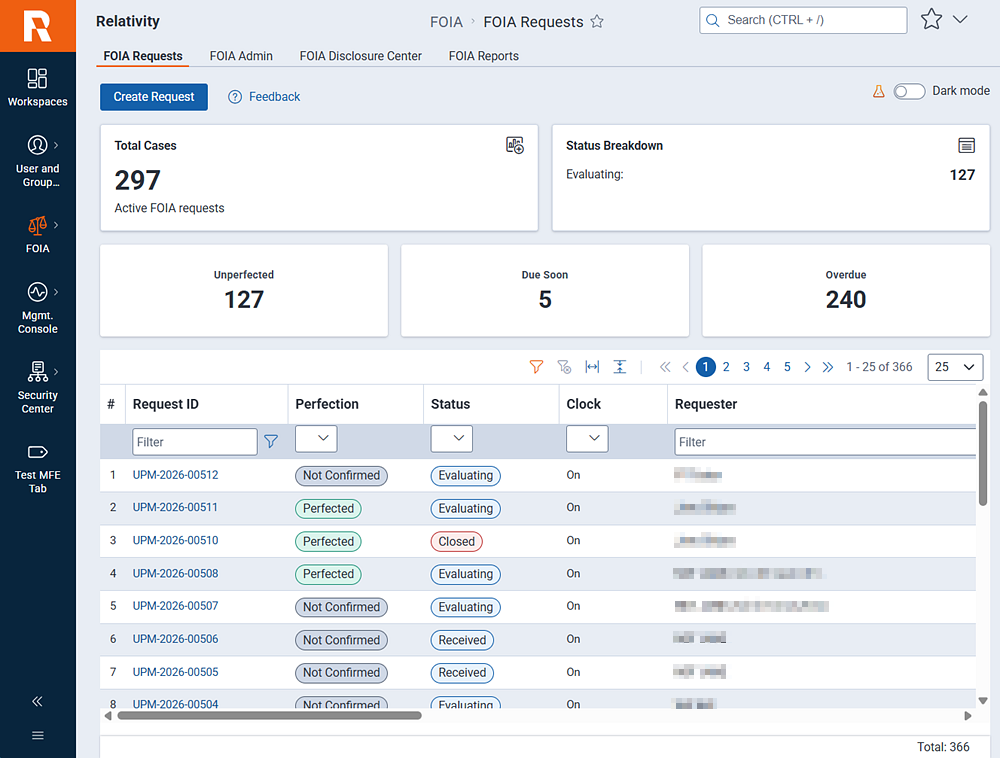
Relativity FOIA portal for agency access.

Dashboard widgets:

  • Total Cases—the total number of active FOIA requests.
  • Status Breakdown—the current number of requests under evaluation, in processing, and waiting for a response.
  • Unperfected—the number of requests that are under review or not complete.
  • Due soon—the number of requests that are reaching the end of the allotted time frame for processing.
  • Overdue—the number of requests that have passed the allotted time frame for processing.

List fields:

  • Request ID—the unique identifier assigned to the request.
  • Perfection—indicates whether the request is complete and meets the requirements of the agency. A non-perfected status indicates the review is not complete or more information is required to process the request.
  • Status—the current status of the request.
  • Clock—indicates if the clock is running. Relativity follows DOJ rules for starting and stopping the clock. The clock starts when the request is received. If the request is not perfected, then the clock is stopped until perfection is achieved. After perfection, the clock starts again.
  • Requester—the person submitting the FOIA request.
  • Assigned Component—the office, agency, or person assigned by the reviewer to search for and provide documents.
  • Date Submitted—the date the request was submitted.
  • Fee Waiver—indicates the status of the fee waiver, if requested.
  • Due Date—the due date for completing the request processing.
  • Days Overdue—the number of days the request processing is overdue.
  • Fee Category—the fee category confirmed by the assigned officer.
  • Case Complexity—indicates the estimated amount of time and effort for processing the request. Options include simple, complex, and expedited. See (FOIA Intake) Processing Track for more details.
  • Last Updated—indicates the date the request was last updated.
  • Date Completed—indicates the date the request was completed.
  • Organization—the requester's organization, if any.

FOIA Workflow

The FOIA process begins with a request for documents. Once the request is received, the FOIA workflow starts with the Intake step. In all, there are four steps to the workflow:

  • Intake—begins after a document request is received. The agency reviews the request and decides whether it passes FOIA submission policies. The response clock starts when the request is received.
  • Search—if the request is perfected (all of the FOIA submission guidelines are met), agencies then locate records that are responsive to the request.
  • Review—during this phase, agencies assess the records to determine the appropriate level of release (such as partially or fully released) in accordance with legal requirements.
  • Response—in this final step, agencies deliver the records to the customer. The response clock stops.

Permissions

Relativity feature permissions are assigned through groups, which are then applied to workspaces, object types, tabs, and individual items. Administrators have precise control over feature actions accessible at multiple levels.
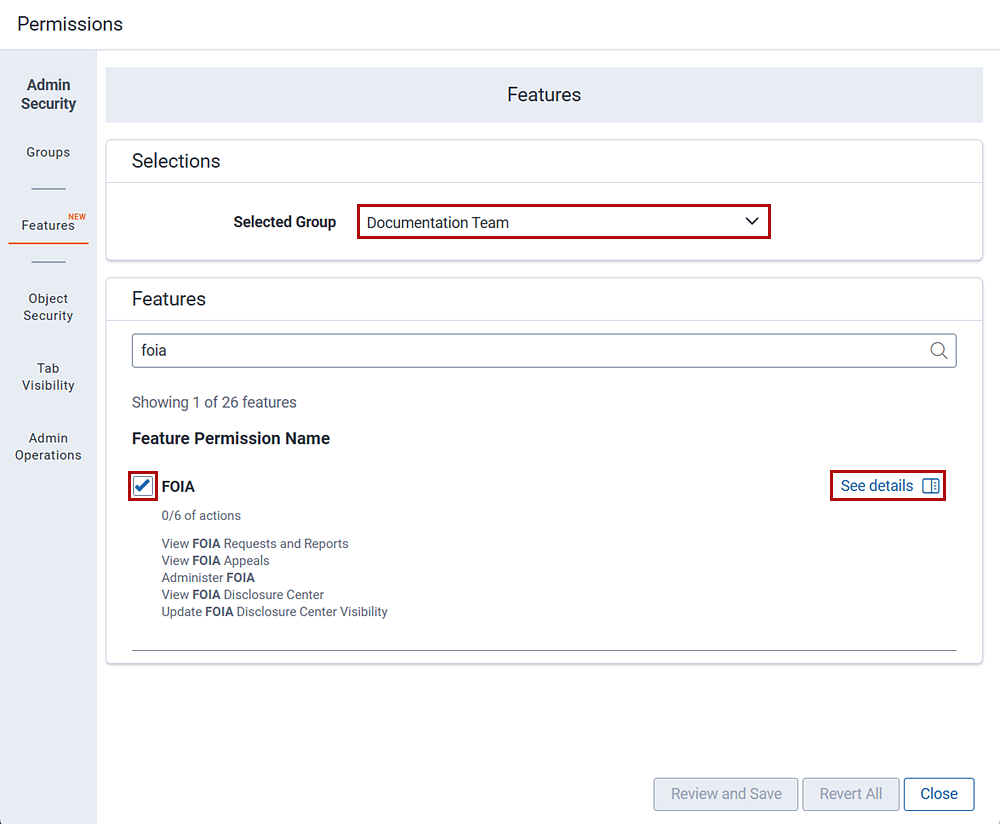
The permissions screen showing foia access and foia visibility active.

To access FOIA feature permissions:

  1. Use the search bar to navigate to Instance Details.
  2. Click Manage Permissions.
  3. Select the Features tab.
  4. Use the Select Group drop-down menu to select the group for which you want to view permissions. If you do not know which group to select, contact your Relativity administrator. Groups and group assignments are managed by an organization's Relativity administrator.
  5. Scroll down and check the box next to FOIA. You can also use the search bar to jump to the FOIA settings.
  6. Click See details.

A modal appears listing the actions associated with FOIA. One item to note is the Preset drop-down menu. When you select a preset, Relativity selects the actions defined for the preset. You can then add or clear actions as needed.
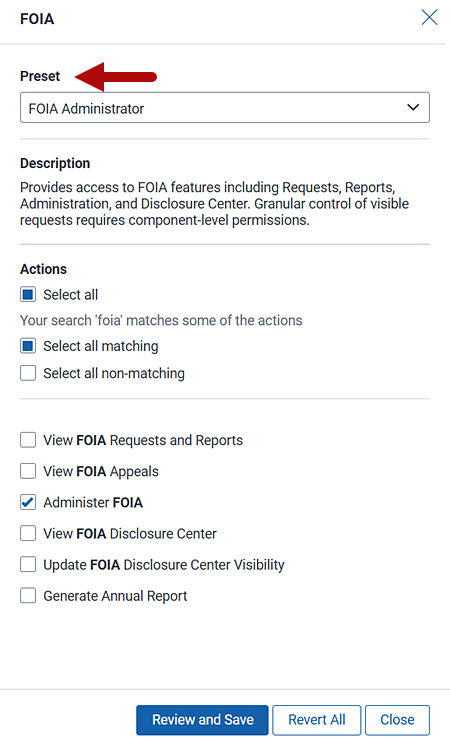
Feature permissions modal showing preset otpions and selected actions.

To add or edit actions:

  1. Check or clear actions as needed.
  2. Click Review and Save. Expand the Features changes section for FOIA to view all of the changes made to permissions in the current session. This button is only enabled if you changed action settings.
  3. Click Save.
  4. Click Close to exit the screen if you did not change any settings.
Feedback